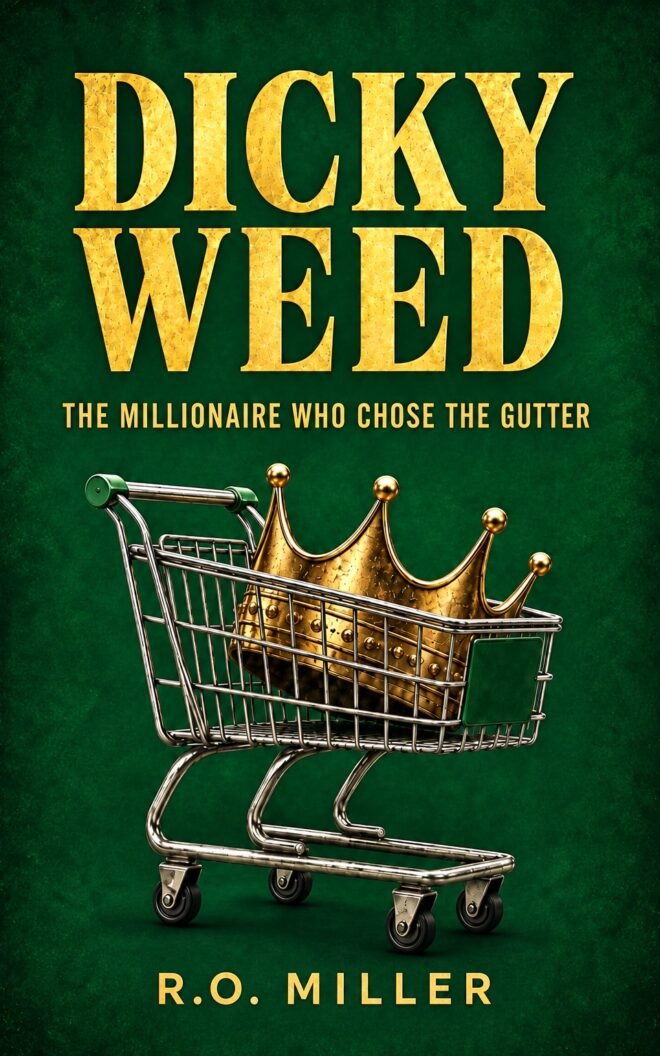
Richard Aurelius Weed III has seven hundred million dollars, a Bel Air mansion, a personal chef, a melancholic octopus, and an emotional-support parrot named Nietzsche.
What he does not have is an authentic life.
When a forgotten drizzle of truffle oil triggers an existential crisis, Dicky decides the problem is not the risotto. The problem is everything. He locks his fortune into an irrevocable trust, loads three cashmere sweaters and one extremely expensive bird into a chrome shopping cart, and sets out to spend a year homeless on Skid Row.
He expects hardship. He expects revelation. He expects, eventually, to become profound.
He does not expect the people already living there to recognize his spiritual experiment for what it is. He does not expect hunger to be less poetic than advertised, concrete to be less forgiving than a mattress, or a shopping cart religion to acquire a disciple. And he certainly does not expect a private letter to leak, turn him into viral content, and attract the exact kind of people who believe suffering becomes meaningful once somebody points a camera at it.
While Dicky attempts to lose his ego, fifteen miles away the collection of geniuses managing his fortune discovers cryptocurrency.
Told through nine escalating Parts and a sequence of found documents from the collapse, Dicky Weed is a dark contemporary satire about wealth, spectacle, poverty tourism, influencer empathy, institutional stupidity, and the dangerous human need to make a story out of everything.
It is also about a simpler distinction that Dicky takes far too long to understand: choosing to have nothing is not the same as having no choice.
Content advisory
Contains profanity, homelessness and rough sleeping, bodily-function and sanitation humor, food insecurity, malnutrition and dental deterioration, mental disorientation and paranoia, institutional neglect, police contact, social-media exploitation, and crude humor. Violence is limited and not graphically depicted. Romantic content is minimal.