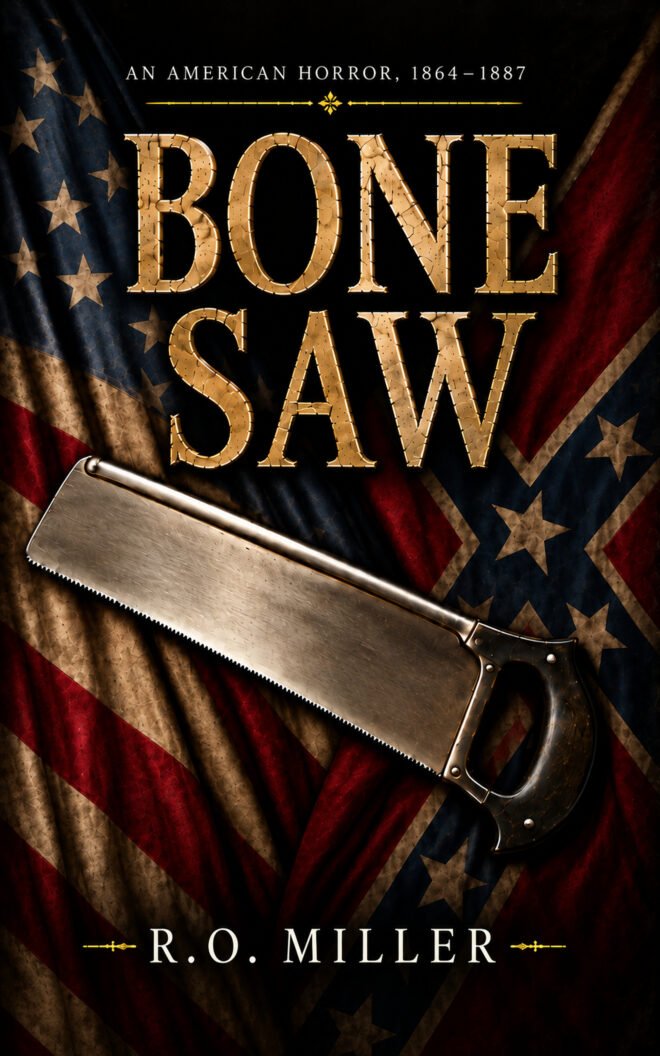
The saw begins as inventory.
Forged in New York, fitted into a Federal surgical case, and sent south with hospital stores, it is an ordinary instrument made for necessary work. When the case is left behind in the confusion of war, Confederate surgeon Augustus Mercer recognizes its quality. Under canvas and lantern light, with wounded men arriving faster than hands can treat them, necessity becomes speed. Speed becomes certainty. Certainty begins to demand its own proof.
The war ends. The instrument enters commerce.
At a surplus auction, the complete case passes to Theodore Ballard, a disciplined Chicago physician who distrusts unanswered questions. The city gives him factories, rail yards, fire, laborers whose bodies have already been priced by employers and benefit societies, and a medical profession eager to turn survival into statistics. Ballard keeps the instruments bright. The ledgers grow. The distance between observation and decision narrows.
Years later, the case travels again, westward, into a Wyoming settlement where distance grants a doctor freedom from scrutiny and the earth keeps what professional records do not. Yet the fitted case remains whole, cleaned and ordered after every use, while patients, families, workers, and communities absorb the cost.
Spanning the Civil War through 1887, Bone Saw is a literary historical gothic horror novel about medicine, ambition, ownership, and the violence that civilized systems learn to call necessary. The saw never speaks. It never moves by itself. It may not need to.
Content advisory
Contains graphic historical surgery and amputation, wartime injury, medical coercion, infection and gangrene, severe burns, labor-related injury, animal consumption of human remains, buried remains, self-inflicted bodily harm, and death.